



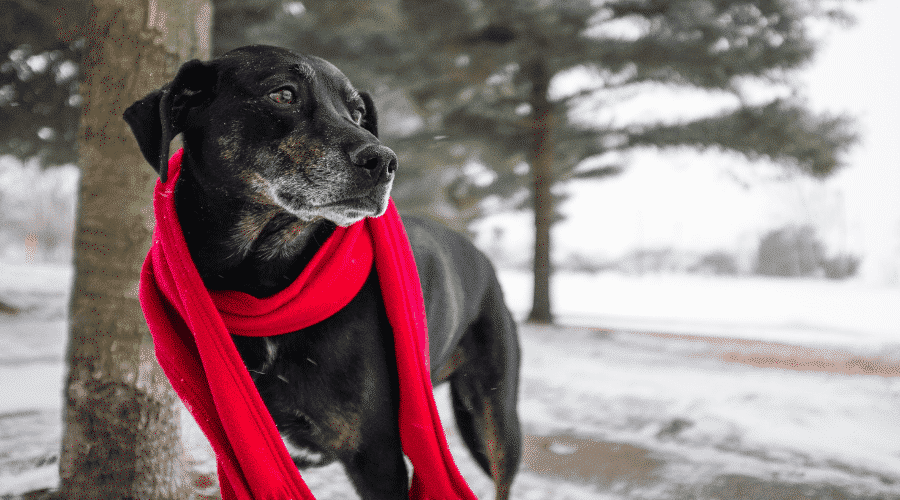
You may believe that dogs are never cold. They have fur all over the body, hence they are always warm. This is partially true. Some breeds, like the Siberian husky, are bred for very cold climates. Others are not, and they can be cold like you. How cold is too cold for dogs? Well, this is the topic we are going to answer today. Stay tuned.
How Cold Is Too Cold For Dogs?
Well, the answer is 45 degrees Fahrenheit. Anything above it, and your dog will feel warm, and there is no need to take any actions. Anything below 45 degrees, and your dog will be cold. This is not a huge problem. Most dogs can withstand this temperature without any issues. But, at this temperature, most dog breeds will be at least partially cold.
When the temperature is 32 degrees Fahrenheit or below, all senior dogs, puppies, small breeds, and all dogs with short and thin fur will need a sweater or a coat. This is mandatory. What if the temperature is 20 degrees Fahrenheit? Well, this is very cold for dogs, and you will need to take certain precautions to keep them warm. It is not advised to let small breeds and those with thin fur outside when the temperature is this low.
We must add that this is not something that can be 100% generalized. Some dogs will still be comfortable with a coat at 60 degrees Fahrenheit, so you will need to make them wear one even at this temperature.
Signs Your Dog Is Too Cold
For most people being able to tell when their dog is too cold is not an easy task. How cold is too cold for dogs and how can you tell? Well, this will be answered in this section. You need to know that dogs can catch a cold just like you. This means that they will display the same or at least similar signs when cold, just like you.
The most common signs are anxiety, keeping one paw elevated at a time, slow movement, whining, and shivering. Keep in mind that your dog can display all of these signs or just one. It depends on numerous factors and we cannot generalize the matter.
It is also very common for a dog to search for a warm place to spend some time. They will probably lie down next to a heating and warm body in the house. At night, they may want to spend more time in bed with you. In general, there are countless ways dogs will try to keep themselves warm and they will always do it when cold, obviously.
Some Dogs Need Coats and Sweaters While Others Don’t
As you can assume, some dogs are more tolerant of low temperatures; hence, they will need a coat or sweater when the temperature is low. Others will never need these things. Once again, we can see the Siberian husky as the best example. Dogs who are bred to live in cold temperatures will never need coats, sweaters, or anything similar. But, most pets these days are not Siberian Husky or a similar breed hence they may need a coat or sweater. There are 3 cases when you will want to use coats to keep your dog warm at low temperatures.
- All dogs who have thin and short fur will need a coat when the temperature is low and you want to get them outside for a walk. The best examples are whippets and greyhounds. But this applies to all dogs with this type of fur.
- All small dogs need this as well. They are still unable to generate as much heat as adult dogs, and as such, they need help from you. Think of them as babies. Babies always need more layers of clothing than adults.
- Senior dogs will need a coat as well. The ones with arthritis are in an even more severe state, and they must keep joints warm at all times. In general, senior dogs usually do need a coat when the temperature is low.
Yes, we must add the opposite facts. Large dog breeds do not need coats. The ones with thick fur, such as Golden Retrievers, will never need a coat. You can check and see if your pet is more comfortable and warmer when wearing a coat or not. You need to know what your dog needs, and you need to help him adapt.

Guide You Can Use To Tell When Your Dog Is Cold
Below, we can see a few factors that will help you determine when your dog is cold. There is no need to tell you that not all dogs are equal and that there are a lot of variations. Well, you can use these factors to tell when your dog will be cold and you need to react.
-
Type of coat
We have mentioned this already. In general, dogs with a thick and long coat are not going to freeze as easily as those with a short and thin coat. On the other hand, those with thick coats cannot withstand high temperatures very well.
-
Color of the coat
Did you know that the colour of the coat can be a valuable factor here as well? All coats that are black or grey are able to absorb sunlight much better during the day. As such those dogs will be able to stay warm when the same dog with the same fur, but in white color is cold. This is not a huge factor to consider, but it is still important and should be taken into account.
-
Size
Small dog breeds will lose their body temperature much faster than big dogs. This means that they will be cold much sooner than a large dog.
-
Weight of a dog
This doesn’t have to do with the breed you have. We are referring just to the weight of a dog. If you have a large dog who is skinny, he will be cold much sooner than the same dog breed with more weight. Fat is the best insulator and is commonly used for this purpose. So, if your dog is heavy due to added fat, he won’t be cold all the time. Many animals in nature will eat more to generate more fat, which will keep them warmer during the winter.
-
Conditioning
Dogs that spend a lot of time in areas where the temperature is low (for instance, they live in cold areas) will be able to adapt to and withstand low temperatures much better. On the other hand, those who live in warm areas won’t be able to withstand low temperatures well. This is something that can be seen among people as well.
-
Health and age
Puppies and senior dogs are unable to manage their body temperature as well as young and strong dogs. This simply means that puppies and senior dogs will be cold much sooner and at higher temperatures than adult dogs. If you recall, we did mention that these dogs do need an added layer of clothing to keep them warm when the temperatures are very low.
Dogs Usually Don’t Need Boots
When we are talking about coats and cold weather, we must address boots. Most dogs do not need boots. They are bred not to wear these, and as such, there is no need to make your dog wear them. But, there are a few cases when we can see boots as a valuable option and even a mandatory one.
- Dogs who have injured their paw or a leg will need to wear boots. This is an ideal way to keep them protected and safe at all times. There are special and very comfortable boots for dogs. If he doesn’t wear these, dirt, ice, and all the rest can make the injury even more severe and cause additional problems.
- In those areas where de-icers that are not suitable for dogs are used, owners need to use boots for their dogs. These de-icers are dangerous, and they can injure the paws by burning them. There are safer alternatives you can see and find, so you may want to try to convince your local community to use those. They are still effective.
- All of you who like spending hours and hours outside with a dog and hiking when the temperature is low will need to invest in a decent pair of boots for your dogs. This is more of a precaution than anything else, and it will have a positive effect.
The Final Word
How cold is too cold for dogs? Well, now you have all the answers and all the main elements you need to know. These are important facts and for most owners it is mandatory to memorize them as soon as possible. As always, you should do everything you can to keep your dog warm at all times and to protect him from catching a cold.
Recommended Readings:
- How Often To Express Dog Glands.
- Why Do Dogs Snore? Common Reasons.
- How Do You Know If Your Dog Is Dying From Kidney Failure.

